



Before Spotify, Before Followers – A DJ’s Essay on What It Used to Take to Get In the Door

A Minidisc, a Pioneer 200 and One Email
I never planned to become a DJ. I didn’t have the money for it, the connections, or the right surname. What I had was a Minidisc recorder, an obsessive relationship with music, and the blind conviction that if I just sent the right email to the right person, something might happen.
The Pioneer CDJ-200 I learned on had its BPM display covered with masking tape.
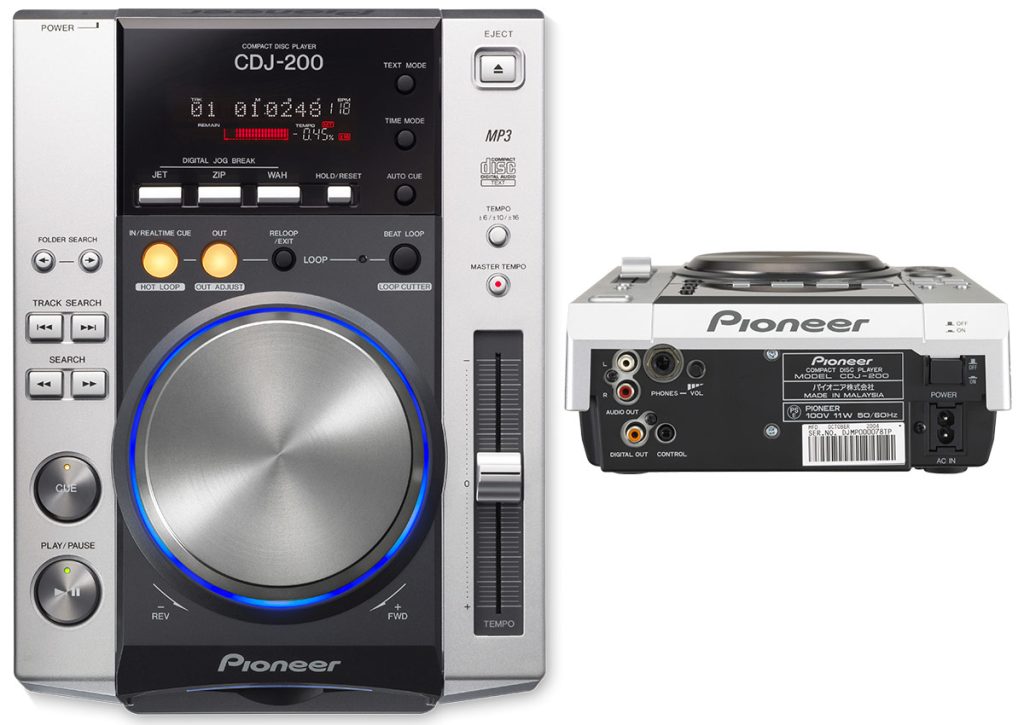
The guy who sold it to me or rather, let me pay it off in instalments, because that’s what you did when you couldn’t afford things outright said it would make me lazy if I relied on it. He was probably right. For six months I beatmatched by ear, by feel, by the kind of obsessive repetition that borders on self-punishment. No app. No sync button. Just the pitch fader and the conviction that eventually my ears would stop lying to me.
After six months, I recorded a mix onto a Minidisc. It wasn’t clean. The transitions weren’t surgical. But the selection the arc of the music, where it started and where it ended up that felt like something. I knew it was good. Not technically. But truthfully.
So I sent an email to Brano DJ.

He was a DJ at Cafe del Fun, which ran under Funradio.sk one of the strongest dance music brands in Slovakia at the time. I had no business emailing him. He had no reason to reply. He called me the same day.
That call changed everything. Brano’s support, and through him the wider circle of Cafe del Fun DJs, gave me my first real foothold. That was 2006, and I was getting acquainted with terms like groove, vocal, and everything that orbited house music at the time. I ended up being known as the youngest DJ playing funky and vocal house in Slovakia, and I held an almost orthodox line on what that style should sound like uncompromising enough that it occasionally provoked stormy reactions from other DJs who thought I was being precious about it. But that same stubbornness earned me recognition among the people who actually mattered in the scene, and it filled my calendar with private parties and branded events.
My record bag filled up steadily with labels like Defected and Purple Music imprints that became something close to a syllabus for me in those first years.
2012 brought a turning point. My ear started drifting away from vocal house toward something darker and more hypnotic. The real shift had a name: Cocoon Records, and through it, Sven Väth. Hearing what he was doing the patience in it, the way a single groove could hold a room for twenty minutes without needing a hook rearranged something in how I thought about a set.
I moved to Prague in 2018 not chasing a DJ career, just a nicer city and better options in general. It took roughly another year before I sat down and sent a round of emails to Prague clubs, attaching my DJ profile and more importantly video sets filmed live off turntables, so they could actually see the mixing and the selection, not just take my word for it. Out of everyone I reached out to, exactly two venues wrote back: Bar Cobra and Groove Bar.
That’s the part that stuck with me. Someone responsible for a club’s programme let a complete stranger into their space, based on nothing but how he selected music. No referral, no shared history, no follower count. Just a video, a mix, and a decision to take a chance. That’s the thing I think has quietly disappeared since.
Lights, Sound and Burning CDs
It started long before I ever touched a mixer, and long before stage lighting. Around 1998 or 1999, toward the end of elementary school and into the start of high school, TV was genuinely one of the only access points I had to music that spoke to me.
The town I grew up in didn’t really have the internet yet that arrived closer to 2000 so there was no other door to speak of. The one exception was my cousin, who used to buy Dream Dance compilation CDs abroad and bring them back. Those CDs were my other window into club music a glimpse of something happening somewhere else entirely. Mostly, though, it was TV. I was recording music off television.
Shows like Club Rotation on Viva, and a handful of similar stations, became my unofficial school. The tracks were commercial, sure, but they were a different kind of commercial from anything else on offer where I lived. I’d run a cable from the TV’s audio output straight into my PC and save whatever came through as MP3s, waiting for the right track to come on, building private compilations out of whatever caught me.
It wasn’t sampling it was capturing, hoarding, curating, long before I had the word for any of it. Later, once I finally had real internet access, the appetite didn’t shrink, it just changed shape: I started downloading entire albums. I won’t pretend that was legal. It wasn’t then and it isn’t now. But it was also the only library a kid with no money had access to, and it taught me to listen across whole records rather than single tracks which, I’d later realise, mattered more for DJing than almost anything else I picked up.
I burned CDs for friends, for myself, for anyone who’d take them. In retrospect, that was curation. I just didn’t have the word for it yet.
After high school, I started working for a company that handled stage lighting and PA systems the infrastructure that makes nights happen. I was the person who showed up early and left late, who ran cables and loaded gear and watched soundchecks from the wings.
That technical background matters more than it might seem. I understood what sound actually was before I tried to make it do something. I’d heard the difference between a system that was set up with care and one that wasn’t. I knew what a well-tuned room felt like in your chest. When I finally stood behind a mixer, I wasn’t just pushing faders, I was thinking about the whole chain, from the needle to the speaker to the person standing in front of it.
That context the unglamorous, pre-digital, partly illegal context is almost entirely absent from how people come to DJing today. And I think that absence leaves a mark.
From CDs to Records: A Deliberate Slowdown
I made the switch to vinyl within my first year of playing out. It wasn’t forced on me. It was a choice a deliberate one and at the time it felt almost counterintuitive, like choosing to write letters when everyone else was sending texts.
CDs were faster. More forgiving. Easier to carry. Vinyl was expensive, physically demanding, and unforgiving of sloppy preparation. You couldn’t just download a track and play it that night. You had to find the record, buy it, clean it, listen to it properly, figure out where it sat in a mix. The whole process had friction built into it.
That friction, I came to understand, was a feature. Not a bug.
When you’re forced to invest time and money into every record you play, you stop treating music as interchangeable raw material. Each track carries weight — literal and otherwise. You play differently when you know what each piece of vinyl cost you to obtain. You listen differently. You choose differently.
I run Divert Records now an online vinyl shop specialising in electronic music. Every second-hand record that passes through goes through roughly 25 minutes of work: cleaning, photographing, and recording full audio direct from the turntable so buyers can actually hear what they’re getting. Not a 30-second preview algorithm. The whole thing. That process isn’t a business model it’s a philosophy. The friction is the point.
The Journey Set Is a Dying Art
When I play, I play long. Five hours minimum, usually. Not because I’m trying to prove something, but because that’s how long it takes to actually go somewhere.
The structure is roughly consistent: Deep house to start, something hypnotic and low-pressure that lets people arrive, order drinks, find their feet. Then a slow migration toward minimal. By the third hour, the temperature rises Tech house, the space between tracks tightening, the room getting denser. By hour four or five, we’re in Techno. Not as a genre declaration, but as a destination the place the whole evening has been pointing toward.
It sounds obvious when I describe it. A beginning, a middle, an end. A narrative.
But watch how most DJs especially younger ones approach a set today, and what you see is something closer to a highlight reel than a film. Disco into drum & bass into techno inside of 45 minutes. Every drop a peak. No valley, no patience, no trust in the audience to stay with you through a quieter moment.
I’m not blaming the DJs. I’m blaming the conditions they’ve been trained in.
The same shortened attention span that plagues social media audiences has, somewhere along the way, infected the DJs themselves. When the metric for a successful set is the clip that goes viral the moment of maximum impact extracted from context then the entire set becomes organised around producing those moments. The journey is dead. Long live the drop.
There are young DJs out there learning on vinyl, documenting the process on TikTok, talking about beatmatching by ear and the importance of record selection. I see them. I respect them. That’s not nothing that’s actually something worth acknowledging. But they are exceptions in a landscape where the defaults pull hard in the opposite direction.
Emancipation as a Double-Edged Blade
DJing is more accessible now than at any point in its history. That’s genuinely good. The financial barrier that once made the craft the preserve of a certain type of person usually a specific type of man, usually from a specific social background has largely collapsed. A laptop and a controller can cost less than a month’s worth of coffee. The knowledge that once circulated in record shops and on pirate radio is freely available on YouTube. The gatekeeping that felt natural in 1998 looks like an embarrassing relic now.
And yet.
The barriers that fell weren’t arbitrary. Some of them were genuinely exclusionary and deserved to fall. But others were filters not gates, but slow-down mechanisms that performed a quiet sorting function. The time and money required to build a record collection forced a certain level of commitment before you ever stood behind a mixer. The difficulty of beatmatching by ear meant you’d spent real hours with the music before you could present yourself as a DJ. The cost of a night playing badly in public was high enough that you prepared.
Remove those filters and you democratise the access. But you also flood the room.
A 2025 survey by the Pete Tong DJ Academy, presented at IMS Ibiza, polled 15,000 emerging DJs. 62 percent said the electronic music scene felt like a closed club. 61 percent said social media presence mattered more than musical talent. 52 percent reported experiencing anxiety or burnout. These are not the numbers of a healthy ecosystem. These are the numbers of a system that replaced one set of gatekeepers with another less visible, more brutal, and entirely indifferent to whether you’re actually good.
The old gatekeepers kept you out because you hadn’t paid your dues. The new ones keep you out because you don’t have the right followers.
The New Gatekeeping Has Nothing to Do with Music
Collectives have always been selective. That’s not new, and in some forms it’s healthy a group of people with shared aesthetic values protecting the integrity of what they’re building. The right people in the right room, as the phrase goes.
But something has shifted. The selectivity I encounter now is less about music and more about optics. The question isn’t whether you can read a room. It’s whether your presence on a flyer is worth something in the algorithm’s eyes. Whether your follower count justifies the booking fee. Whether you’ve done the brand work that makes you easy to sell.
That’s a fundamentally different kind of closed door. And it’s one that the music itself can’t open.
I’ve watched people with extraordinary ears people who understand music at a depth that most headliners never will remain invisible because they never figured out content strategy. And I’ve watched people with mediocre selection skills and an impeccable Instagram presence accumulate bookings at a rate that has nothing to do with what they do behind a mixer.
Szatan’s recent piece in Resident Advisor published just this month frames this as part of a broader problem: the conditions that once allowed radical art to emerge have been systematically removed. Cheap rents, functioning social safety nets, an independent nightlife that didn’t need to justify itself to investors these things created space for risk. Without them, the argument goes, you get iterations of the familiar wrapped in new packaging. The underground runs out of oxygen and starts breathing recycled air.
That rings true to me. Though I’d add: the underground can also suffocate itself from the inside, when the gatekeeping logic of the mainstream gets internalised and turned inward.
The Internet Forgets. A Record Doesn’t
There’s a second piece by the same RA writer, published a few weeks after the one on gatekeeping, that I keep thinking about. It’s about archiving about how much of electronic music’s collective memory lives only online, on platforms with no obligation to keep it there. Entire scenes, entire mixes, entire histories have vanished overnight when a server got sold off or a company decided a back-catalogue wasn’t worth the storage cost. The piece argues that we’ve traded something durable hard drives, magazines, physical objects for something that feels permanent but isn’t.
I didn’t go looking for that argument. But it landed on something I’d already been circling without naming it.
When I started Divert Records, the decision to record full audio off the actual turntable for every second-hand release wasn’t about competing with Discogs previews. It was about something closer to what that archiving piece is describing. A digital file with no physical anchor can disappear the moment a platform changes its policy or its ownership. A record sitting on a shelf, with its condition documented and its sound captured at the point of sale, doesn’t have that problem. It can outlive the company that sold it. It can outlive me, frankly.
That’s not a small thing in a culture that increasingly lives and dies online, as the piece puts it. The same forces eroding who gets to be heard the social-media-first gatekeeping I described above are part of a bigger pattern: a culture optimised for visibility today and indifferent to whether anything survives until tomorrow. A closed Instagram account and a dead MySpace migration are different sizes of the same problem.
I don’t think the answer is nostalgia for physical media as some kind of moral position. Plenty of vinyl culture is exactly as exclusionary and content-driven as anything on TikTok. But there’s something worth defending in the idea that a curated, physically documented object resists the kind of erasure that a feed can’t. Slow process, in that sense, isn’t just an aesthetic choice. It’s a small bet against forgetting.
More DJs Than Ever. Harder to Break Than Ever
Here is the situation as I understand it: there have never been more DJs. The tools have never been cheaper, the information never more freely available, the technical threshold never lower. By every quantitative measure, the field has never been larger or more open.
And yet the pipeline that moves a talented person from their first gig to a position where they can sustain themselves on music has never felt more clogged. Festival lineups are dominated by names whose defining work is fifteen or twenty years old. The mid-tier DJs who might once have cycled out and created space are hanging on not because they’re undeserving, but because the economics of leaving don’t make sense when there’s nothing to land on.
The result is a paradox that the IMS data makes visible: the more open the access at the entry level, the more closed the upper levels become. Democratisation at the bottom. Calcification at the top. Everyone can start. Almost no one can break through.
This isn’t a unique problem. You find versions of it across creative industries wherever digital distribution has simultaneously lowered barriers to entry and raised the noise floor. More musicians than ever but fewer can make a living. More writers than ever but fewer staff positions. More DJs than ever but the same forty names on every festival poster.
The difference in electronic music is that this dynamic sits in tension with an ideology the belief, still nominally held, that the underground exists in opposition to exactly this kind of consolidation. We haven’t admitted to ourselves yet that we’ve built, more or less, the thing we said we were against.
Not Nostalgia. A Question
I’m not writing this as a defence of how things used to be. The scene that gatekept me in the early 2000s also excluded a lot of people who deserved to be in it. The elitism of the vinyl world has real ugliness in it, and I say that as someone who has spent the better part of two decades inside that world. I’m not asking for the barriers back.
What I’m asking is whether we’ve actually thought through what we replaced them with.
A Minidisc and a cold email got me in the door because, on the other side of that door, someone was listening for music. Brano didn’t call me back because of my follower count. He called me back because the mix I sent him rough as it was said something. There was a selection logic to it. A point of view. An ear that had been trained, slowly and expensively and often in isolation, to know what it was looking for.
I wonder how many people with that ear are out there right now, making mixes that no one is listening for, because the infrastructure for listening has been replaced by the infrastructure for watching.
The IMS data says 61% of emerging DJs believe social media presence matters more than talent. I don’t think those DJs are wrong to believe that. I think they’re correctly reading the system they’re operating in. The problem isn’t their perception. The problem is that their perception is accurate.
The question worth asking and I don’t have the answer is what it would take to make that perception inaccurate again. What would a scene look like where the person with the best ears, not the best content strategy, is the one who gets the call?
I still believe that scene is possible. The evidence for it is thin. But the desire for it from audiences as much as from the DJs stuck outside the door feels real enough to build on.
That’s not nostalgia. That’s a question. I’m genuinely asking.